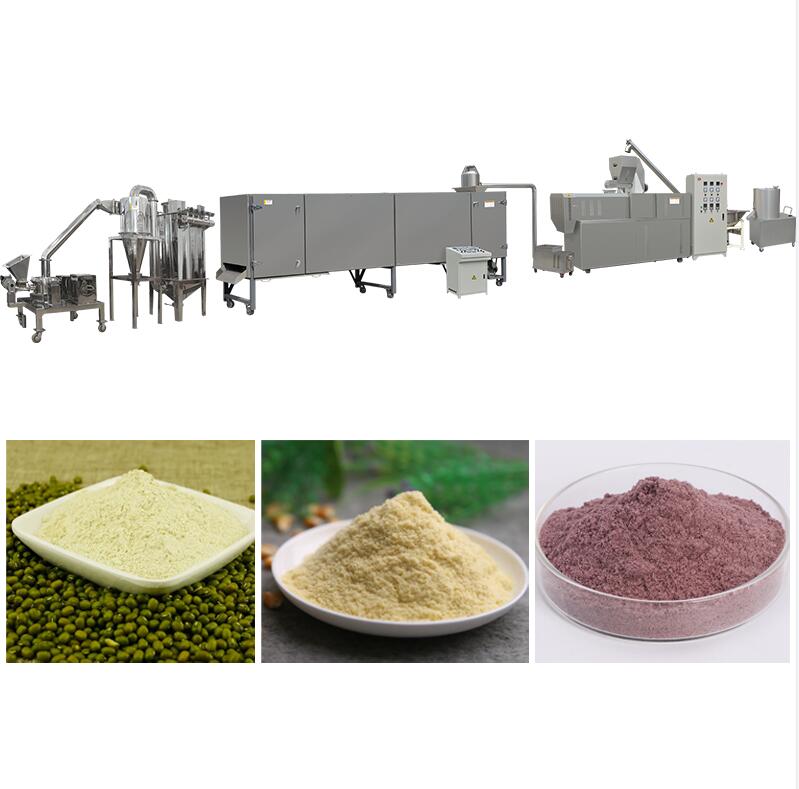
How do extruders for puffed foods self-clean?
The self-cleaning mechanism of twin-screw extruders for puffed food products relies on the mechanical self-cleaning action of co-rotating screws combined with in-line cleaning (CIP)/material rinsing. This, along with standardized procedures, achieves efficient cleaning with minimal or no disassembly, meeting food hygiene requirements.
- Mechanical Self-Cleaning (Integrated into the Screws)
Principle: Standard food-grade twin-screw extruders feature a co-rotating, tightly meshed structure. As the two screw threads rotate, they scrape against each other’s surfaces, continuously scraping off and conveying material adhering to the screw edges and grooves. This is the most basic form of “self-cleaning.”
Key Points:
- Only meshing type (non-non-meshing/differential) machines can effectively self-clean.
- Self-cleaning effect is best when the speed is stable and the temperature is normal.
- Material must be emptied before shutdown; otherwise, the self-cleaning function will fail after the residue hardens.
- Online Self-Cleaning (Standard Procedure for Color Change/Material Change/Shutdown)
- Preparation (Hot Cleaning without Shutdown)
- Temperature: Maintain normal production temperature for each section (or 5–10℃ higher than the processing temperature)
- Speed: First reduce to 10–30 rpm (low speed)
- Close the hopper gate and stop feeding.
- First Step: Empty Residual Material
- Run at low speed to basically empty the raw material in the barrel (discharge becomes thinner and flow stops).
- Do not wait until it is completely cooled and hardened before cleaning.
- Second Step: Cleaning Material Rinsing (Food Grade)
Common Cleaning Materials (Based on Common Uses in Extruded Foods):
- Food-grade PP/PE granules (general purpose, inexpensive)
- Dedicated food-grade screw cleaning material (high efficiency, short time)
- Rice flour/corn starch + Small amount of oil (more suitable for food systems)
Operation:
- Add cleaning material to the hopper and extrude at low speed (15–25 rpm)
- Observe the output:
- Initial stage: Mixed with old material, discolored, with black spots
- Mid-stage: Color lightens, impurities decrease
- Late stage: Output is the original color of the cleaning material, no discoloration, no black spots, no burnt particles → Cleaning complete
- Maintain temperature throughout the process, do not cool suddenly
- Dosage: Approximately 3–8 kg for medium-sized machines, until the output is completely clean
- Third step: Second rinse (before changing to food-grade material)
If the next batch is food-grade raw material, rinse again with the new raw material to ensure no cleaning material residue remains.
- Fourth step: Cleaning the die head / mold / die opening
The die head, template, and cutter must be removed:
Hot scraping → copper brush / food-grade solvent wiping → high-pressure air drying
Use a copper needle to unclog the die opening; do not use a wire brush / Scratching of flow channels by ironware
III. Deep Self-Cleaning (CIP Online Cleaning System)
Suitable for:Long-term production, high-oil/high-starch/prone-to-coking materials
Strict food hygiene (HACCP/QS) requirements
Automated production lines
CIP Process (without disassembly):
- Pre-rinse: Hot water (60–80℃) rinses away loose residue
- Alkaline wash: Food-grade NaOH solution (1–2%), circulates for 15–30 min to dissolve oil and protein
- Intermediate wash: Rinse with clean water to remove alkaline solution
- Acid wash: Food-grade citric acid/phosphoric acid (0.5–1%), neutralizes and removes scale
- Final wash: Rinse with clean water until neutral (pH 6–7)
- Sterilization: Food-grade disinfectant (e.g., peracetic acid) circulates
- Drying: Sterile compressed air drying
Advantages:
- No disassembly required, automated, and recordable
- No dead angles, meets requirements GMP
- Reduce manpower and shorten downtime
- Regular Disassembly and Cleaning (Deep Maintenance, Weekly/Monthly)
- Cool to below 100℃ and disconnect power.
- Open the barrel and remove the screw.
- Screw/Barrel:
- Hot copper brush/nylon brush cleaning
- Stubborn charring: Soak in food-grade solvent + soft scraping
- Strictly prohibited: Flame roasting, wire brush, hard scraping with iron (damages plating/nitriding layer)
- Auxiliary parts:
- Hopper, feeding section, vacuum port, side feeder: Disassemble and clean, wipe with alcohol
- Sealing ring, temperature/pressure probe: Inspect and replace
- Key Parameters and Prohibitions (Must Read for Food Grade)
- Temperature: Cleaning temperature ≥ material melting point, ≤ equipment maximum allowable temperature
- Speed: 10–30 rpm low speed throughout the cleaning process to enhance shearing and prevent overheating and carbonization
- Cleaning material: Must be food-grade, conforming to GB 2760 / Food Contact Standards
- Strictly Prohibited:
- Use of industrial-grade cleaning materials/solvents (toxic residues)
- Hard scraping of cold machine, burning of screw with flame, scraping with metal brush
- Forcibly starting the machine after residue has hardened (damages screw and motor)
- Quick Assessment of Cleaning Compliance
- Output: Uniform color, no black spots, no charred particles, no odor
- Visual Inspection: Screw/barrel shiny, no sticky material, no carbonized layer
- Hygiene: No visible residue after wiping, microbial test passed
VII. Daily Maintenance Recommendations
- Every Shift: End of production → Cleaning and rinsing → Disassembling and cleaning the machine head
- Weekly: Partial disassembly and inspection of screw, die head, and vacuum port
- Monthly: Deep disassembly and cleaning + CIP + lubrication + seal inspection
Written by Лили Динг
WhatsApp:+8613573122583
E-mail:[email protected]