The Manufacturing Process of Puffed Breakfast Cereals


はじめに

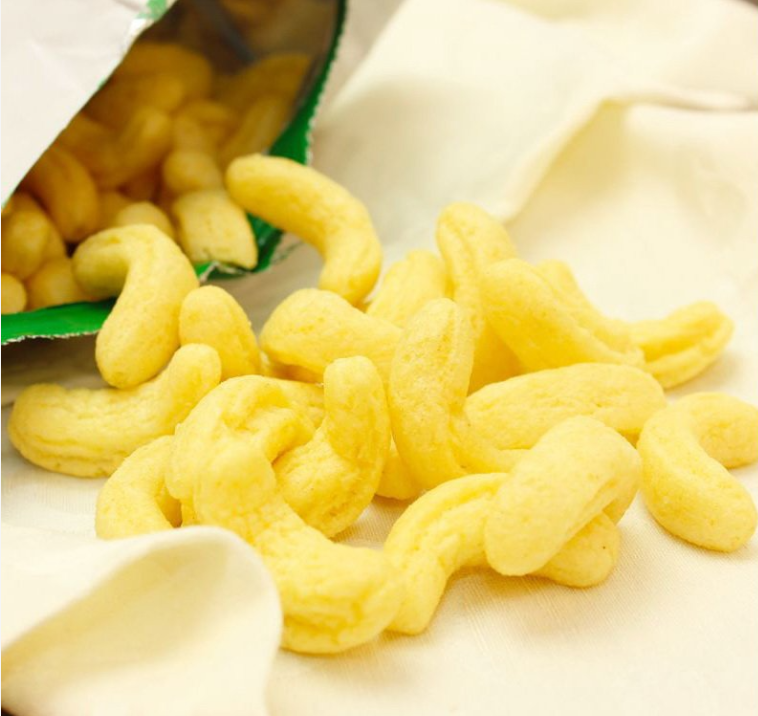
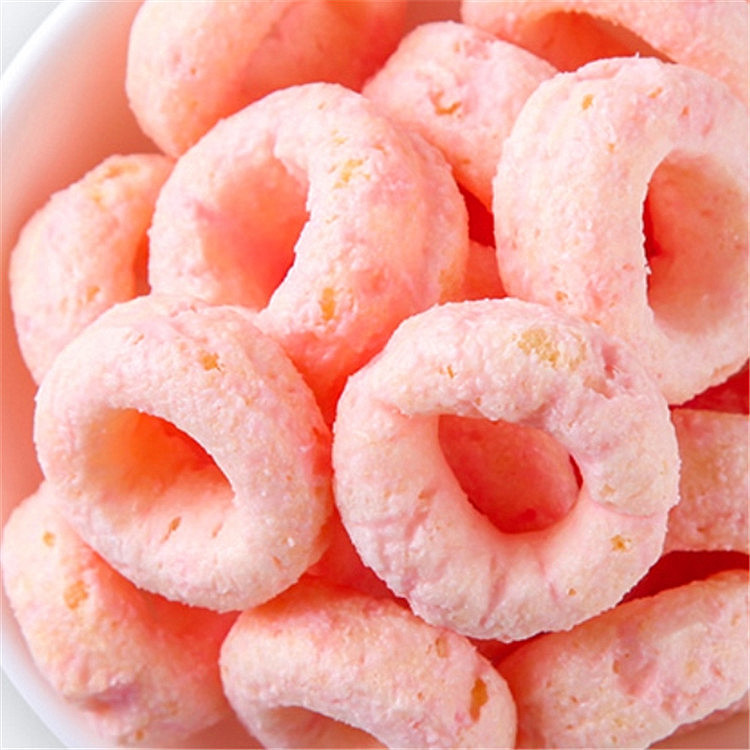
Puffed breakfast cereals have become a staple in households worldwide, offering consumers a convenient, ready-to-eat meal that combines appealing textures with nutritional fortification. These products are primarily made from corn, wheat, oats, or rice, transforming raw grains into light, crispy flakes, balls, rings, or custom shapes . The manufacturing process has evolved significantly since the late nineteenth century, when breakfast cereals first emerged in the United States as health-focused vegetarian foods .

Today, the production of puffed breakfast cereals relies heavily on extrusion technology—a continuous, highly efficient process that cooks, shapes, and expands grain-based formulations into finished products. This article provides a comprehensive overview of the industrial manufacturing process, from raw material handling to final packaging.


Overview of Manufacturing Categories

Ready-to-eat breakfast cereals can be grouped into several categories based on their manufacturing methods. These include flaked cereals (such as corn flakes), gun-puffed whole grains, extruded gun-puffed cereals, shredded whole grains, oven-puffed cereals, granola, extruded expanded cereals, and baked cereals . Among these, extrusion-based processes dominate modern production due to their flexibility, efficiency, and ability to create diverse product shapes and textures.

Raw Materials and Formulation

Primary Ingredients

The foundation of any breakfast cereal is cereal grains. Corn, wheat, oats, and rice are the most commonly used, listed in approximate order of production volume . These grains provide the starch that, when cooked and expanded, creates the characteristic crispy texture of puffed cereals.

Additional Components

Beyond the base grains, manufacturers incorporate several other ingredients:
Sweeteners: Sugar, honey, or malt syrup enhance flavor and contribute to browning during toasting
Flavorings: Cocoa, fruit extracts, vanilla, or malt flavors
Fortificants: Vitamins and minerals are added to meet nutritional standards—heat-stable nutrients are typically added before cooking
– Salt: Enhances flavor and affects starch properties during processing
– Colors: Food-grade colorants may be added for visual appeal

Alternative and Enhanced Formulations

Recent innovations have expanded the range of raw materials beyond traditional grains. Manufacturers now process pulses such as chickpeas and quinoa, responding to consumer demand for higher protein and fiber content with reduced fat, sugar, and salt . Research has demonstrated successful production of breakfast cereals using blends like broken rice and common bean flour (70% rice, 30% bean), achieving good expansion indices and acceptable technological properties . Chestnut flour-based formulations have also been explored, offering unique flavor profiles and nutritional characteristics .

The Extrusion Cooking Process

Extrusion cooking is the core technology in modern breakfast cereal manufacturing. This continuous process combines several unit operations—mixing, cooking, shaping, and expanding—within a single machine.

Principle of Operation

Extrusion relies on the thermoplastic properties of starch. When starch is subjected to heat, moisture, and mechanical shear within a confined barrel, it undergoes gelatinization. As the cooked dough is forced through a die at the extruder outlet, the sudden pressure drop causes superheated water to flash into steam, expanding the material into a porous, puffed structure.

Single-Screw vs. Twin-Screw Extruders

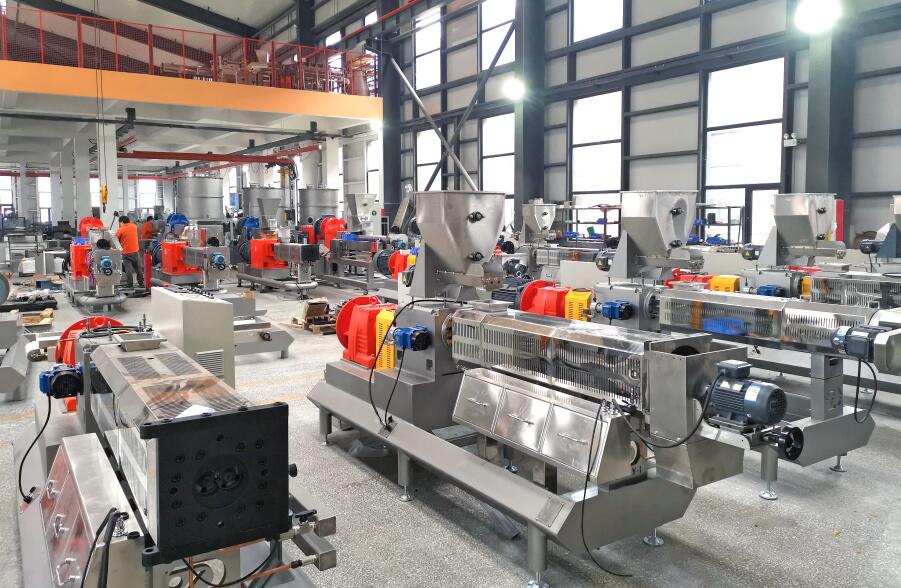
Both single-screw and twin-screw extruders are used in the industry. Twin-screw extruders offer several advantages, including better mixing capabilities, greater processing flexibility, and more consistent product quality . They can handle a wider range of raw materials, including those with higher fat or moisture content, and allow precise control over process parameters.

Extrusion Parameters

Critical parameters that affect product quality include:
Temperature: Typical extrusion zones range from 40°C to 80°C for milder treatments, though higher temperatures are used for direct expansion
Screw speed: Rotary speed influences mechanical energy input and shear
Moisture content: Usually maintained around 14% for proper expansion
Feed rate: Determines production throughput and residence time

In research settings, formulations like rice-bean blends processed at 177 rpm screw speed with 14% moisture have produced expansion indices of 8.89, indicating good volume increase .

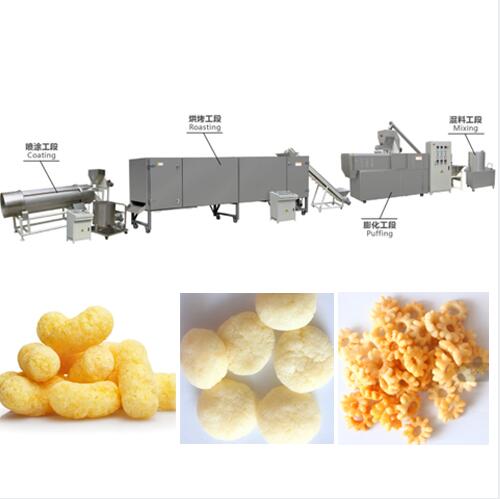
Detailed Process Flow for Puffed Cereals

The manufacturing process varies depending on the desired final product—whether flakes, puffed balls, or filled pillows. Below is a generalized flow applicable to most extruded breakfast cereals, followed by specific variations.

Step 1: Raw Material Handling and Pretreatment

Grains received at the manufacturing facility undergo cleaning to remove foreign materials such as stones, dust, and other crop residues. Some processes require milling the grains into flours or meals, while whole-grain processes may use intact kernels . Pretreatment steps may include tempering—adjusting moisture content to optimal levels before cooking .

Step 2: Weighing and Blending

Dry ingredients—flour, sugar, salt, and dry fortificants—are accurately weighed according to the product formulation and blended in mixers. This step ensures uniform distribution of all components before they enter the extruder . Some processes introduce liquid ingredients such as water, oil, or liquid sweeteners at this stage or via online injection during extrusion.

Step 3: Extrusion Cooking

The blended mixture is fed into the extruder, where it progresses along the screw(s) through distinct zones:

Conveying Zone: The raw material is transported forward, and initial mixing occurs.

Kneading and Cooking Zone: As the material moves forward, mechanical energy from screw rotation and thermal energy from barrel heaters increase temperature. Starch granules absorb water and swell, undergoing gelatinization. Proteins denature. The mass transforms into a viscous, plasticized dough.

Homogenization Zone: Temperature and pressure equalize, ensuring consistent dough properties before exiting.

Die and Expansion: The cooked dough is forced through a die plate with specific orifice shapes (round, star, ring-shaped, etc.). The pressure drop—from high pressure inside the barrel to atmospheric pressure—causes instantaneous water vaporization, expanding the dough into a porous, puffed structure. A rotating cutter at the die face trims the extrudate to the desired length .

ステップ4:乾燥

Freshly extruded products contain relatively high moisture (typically 20-30%). To achieve the crispy texture and shelf stability characteristic of breakfast cereals, moisture must be reduced to approximately 3% . Drying occurs in stages:

Pre-drying: A fluidized-bed dryer removes surface moisture quickly after extrusion .

Final Drying: Convection ovens or additional fluidized-bed dryers reduce internal moisture to the target level while maintaining product integrity .

Step 5: Toasting

For many cereal types, toasting follows drying. This step, conducted in rotary ovens or jet-zone impingement ovens, accomplishes several objectives: it further reduces moisture, develops color through Maillard browning reactions, enhances flavor, and improves crispiness . Toasting parameters—temperature, time, and airflow—are carefully controlled to achieve consistent product characteristics.

Step 6: Coating and Seasoning

After toasting, many cereals receive topical applications to enhance taste and appearance .

Sugar Coating: A sugar syrup solution (e.g., 70°Brix sucrose solution) is sprayed onto the cereal pieces. The coated products are then dried to set the glaze, achieving final sugar content around 35% in some applications .

Fat-Based Coatings: Chocolate, yogurt, or peanut butter coatings may be applied for premium products.

Seasoning: Savory varieties receive salt, cheese powder, or spice blends applied via rotating seasoning drums. Typical seasoning addition rates range from 20-30% of product weight .

Step 7: Vitamin and Mineral Fortification

Heat-sensitive vitamins (such as B-vitamins and vitamin C) cannot withstand the high temperatures of cooking or toasting. Therefore, they are applied after processing, usually sprayed onto the cereal in a solution or suspended in the coating material . This post-processing fortification ensures nutrient retention and label accuracy.

Step 8: Cooling and Packaging

Finished products pass through cooling conveyors to bring them to ambient temperature before packaging. Proper cooling prevents moisture condensation inside packages, which would compromise crispiness. Finally, the cereal is weighed and packaged into bags or boxes in a controlled environment to maintain product freshness .

Flake Cereal Manufacturing (Variation)

Flaked cereals like corn flakes require additional forming steps beyond basic extrusion :

1. Extrusion into pellets: The extruder produces dense, non-expanded pellets rather than puffed pieces
2. Cooling: Pellets are cooled to room temperature
3. Flaking: Cooled pellets pass between heavy rotating rollers that flatten them into thin flakes
4. Drying: Flakes are pre-dried after flaking
5. Toasting: The toasting step both dries and expands the flakes, creating the final crispy texture
6. Coating and packaging: As described above


Gun-Puffed Cereals (Variation)

Some traditional puffed cereals use a batch process called gun puffing rather than extrusion . Whole grains are cooked under pressure in a rotating vessel, then suddenly released through a gun mechanism. The instantaneous pressure drop causes the grain to explode or “puff” to several times its original volume. While less continuous than extrusion, this method produces distinctive textures for products like puffed rice or puffed wheat.


Advanced Technologies: Filled and Co-Extruded Cereals

Recent innovations have introduced filled breakfast cereals, which contain a sweet or savory center within a cereal shell. These products are manufactured using co-extrusion technology .

Co-Extrusion Process

A co-extrusion die combines two streams concentrically: the outer cereal dough and an inner filling (chocolate, fruit paste, cheese, or cream). The combined stream exits the die and passes through a pillow crimper, which forms the continuous tube into individual pillows with sealed edges . The rest of the process—drying, toasting, and coating—proceeds similarly to standard puffed cereals.

This technology allows manufacturers to create high-value products with minimal equipment modifications, offering significant return on investment .


Process Control and Quality Parameters

Key Quality Indicators

Manufacturers monitor several parameters to ensure consistent product quality:

Expansion Index: The ratio of extrudate diameter to die diameter, indicating puffing efficiency. Values around 8-9 are typical for well-expanded products .
Apparent Density: Lower density indicates greater crispiness and better consumer acceptance. Values around 0.25 g/cm³ are common .
Water Absorption Index (WAI): Measures the material’s ability to absorb water, affecting bowl-life (how long the cereal stays crispy in milk) .
Water Solubility Index (WSI): Indicates the fraction of soluble components, influencing flavor release and texture .
Breaking Strength: Reflects mechanical integrity and crunchiness .

Process Efficiency Metrics

Modern puffing technologies achieve high efficiency:
Yields exceeding 95%, minimizing raw material waste
Energy consumption as low as 60 kWh per 100 kg of product—approximately half that of comparable systems
Production capacities ranging from 350 kg/h for development-scale systems to 2,000 kg/h for high-volume industrial lines

The manufacturing of puffed breakfast cereals is a sophisticated industrial process centered on extrusion technology. From raw grain handling through blending, extrusion cooking, drying, toasting, coating, and packaging, each step requires precise control to achieve the desired texture, flavor, appearance, and nutritional profile. Modern lines integrate advanced features such as co-extrusion for filled products, energy-efficient puffing systems, and comprehensive quality monitoring.

As consumer preferences shift toward healthier options, the industry continues to innovate with alternative raw materials (pulses, ancient grains) and formulations that reduce sugar and fat while maintaining the light, crispy texture that defines breakfast cereals. The result is a diverse product category that delivers convenience, nutrition, and sensory satisfaction to consumers worldwide.

Contact :Mark

Whatsapp :8615953166130

Email : [email protected]


請求お見積り
Contact Form Demo

お問い合わせ

今すぐご連絡ください。

Contact Form Demo

食液

タグクラウド